• 💪 Hello, please SIGN-UP FOR A FREE account and become a member of our community!
    You will then be able to start threads, post comments and send messages to other members. Thanks!
  • 🔥 Kits4Less.com #1 MOST LAB-TESTED SOURCE — 25% OFF YOUR FIRST ORDER! 🔥

Analytic Testing Results of Pharmacom Labs Products (concentration, purity, quality)

Status
Not open for further replies.
SB Labs
ANASTRAZOLOS: Anastrozole (Arimidex) from Pharmacom Labs

Analytic testing performed by Janoshik.

RESULTS:
e0hGS89.jpeg

1. Qualitative analysis: the sample contains the active ingredient Anastrozole.
2. Quantitative analysis showed the content of active ingredient: 1.02 mg.

Analysis conducted: 05 January 2024
 
PHARMATROPIN HGH LIQUID: Liquid Growth Hormone from Pharmacom Labs

Analytic testing performed by Janoshik.

RESULTS:
i4pIBhO.jpg

1. Concentration of rHGH in the vial: 3.11 mg/mL.
2. Purity: 95.074%.
3. Dimer and related proteins: not detected.

Analysis conducted: 19 March 2025.


Heavy Metal Analysis:
EcIjRlv.png

  • As: not detected.
  • Cd: not detected.
  • Hg: not detected.
  • Pb: not detected.
Analysis conducted: 18 March 2025.
 
PHARMABOL 100: Injectable Dianabol from Pharmacom Labs

Analytic testing performed by Janoshik.

RESULTS:
8cfoHjL.jpeg

1. Qualitative analysis: the sample contains the active ingredient Methandienone.
2. Quantitative analysis showed the content of active ingredient: 99.99 mg/mL.

Analysis conducted: 13 April 2025
 
TIROS (T3): Triiodothyronine Thyroid Hormone from Pharmacom Labs

Analytic testing performed by Janoshik.

RESULTS:
G0CbDYX.jpeg

1. Qualitative analysis: the sample contains the active ingredient T3.
2. Quantitative analysis showed the content of active ingredient: 48.08 mcg.

Analysis conducted: 16 April 2025
 
OZEMOS: Semaglutide (Ozempic) from Pharmacom Labs

Analytic testing performed by Janoshik.

RESULTS:
oegNGEY.jpeg

1. Qualitative analysis: the sample contains the active ingredient Semaglutide.
2. Quantitative analysis showed the content of active ingredient: 1.97 mg.
3. Quantitative analysis showed the purity of the active ingredient: 98.493%

Analysis conducted: 14 April 2025
 
PHARMA TEST E500: Testosterone Enanthate 500 from Pharmacom Labs

Analytic testing performed by Janoshik.

RESULTS:
5ZXMrYp.jpg

1. Qualitative analysis: the sample contains the active ingredient Testosterone Enanthate.
2. Quantitative analysis showed the content of active ingredient: 463.90 mg/mL.

Analysis conducted: 14 April 2025
 
PHARMA TREN E200: Trenbolone Enanthate 200 from Pharmacom Labs

Analytic testing performed by Janoshik.

RESULTS:
iatijrK.jpeg

1. Qualitative analysis: the sample contains the active ingredient Trenbolone Enanthate.
2. Quantitative analysis showed the content of active ingredient: 204.26 mg/mL.

Analysis conducted: 13 April 2025
 
PHARMA TEST U250: Testosterone Undecanoate 250 from Pharmacom Labs

Analytic testing performed by Janoshik.

RESULTS:
Fp5xiSx.jpeg

1. Qualitative analysis: the sample contains the active ingredient Testosterone Undecanoate.
2. Quantitative analysis showed the content of active ingredient: 255.68 mg/mL.

Analysis conducted: 13 April 2025
 
PHARMA TEST C250: Testosterone Cypionate 250 from Pharmacom Labs

Analytic testing performed by Janoshik.

RESULTS:
K2NpFQN.jpg

1. Qualitative analysis: the sample contains the active ingredient Testosterone Cypionate.
2. Quantitative analysis showed the content of active ingredient: 244.91 mg/mL.

Analysis conducted: 13 April 2025.


Heavy Metal Analysis:
Rig9wi2.jpg

  • As: not detected.
  • Cd: not detected.
  • Hg: not detected.
  • Pb: not detected.
Analysis conducted: 14 April 2025.
 
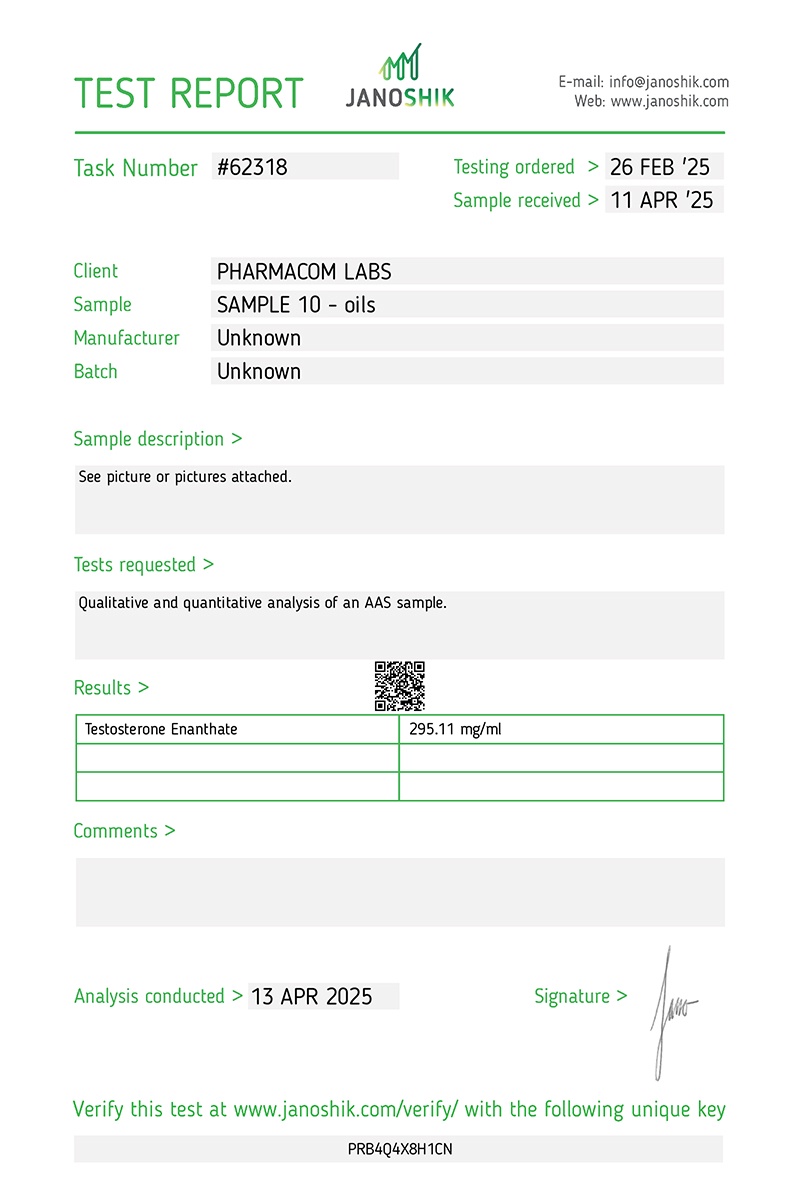
PHARMA TEST E300: Testosterone Enanthate 300 from Pharmacom Labs

Analytic testing performed by Janoshik.

RESULTS:
Lu1WrJh.jpg

1. Qualitative analysis: the sample contains the active ingredient Testosterone Enanthate.
2. Quantitative analysis showed the content of active ingredient: 295.11 mg/mL.

Analysis conducted: 13 April 2025.


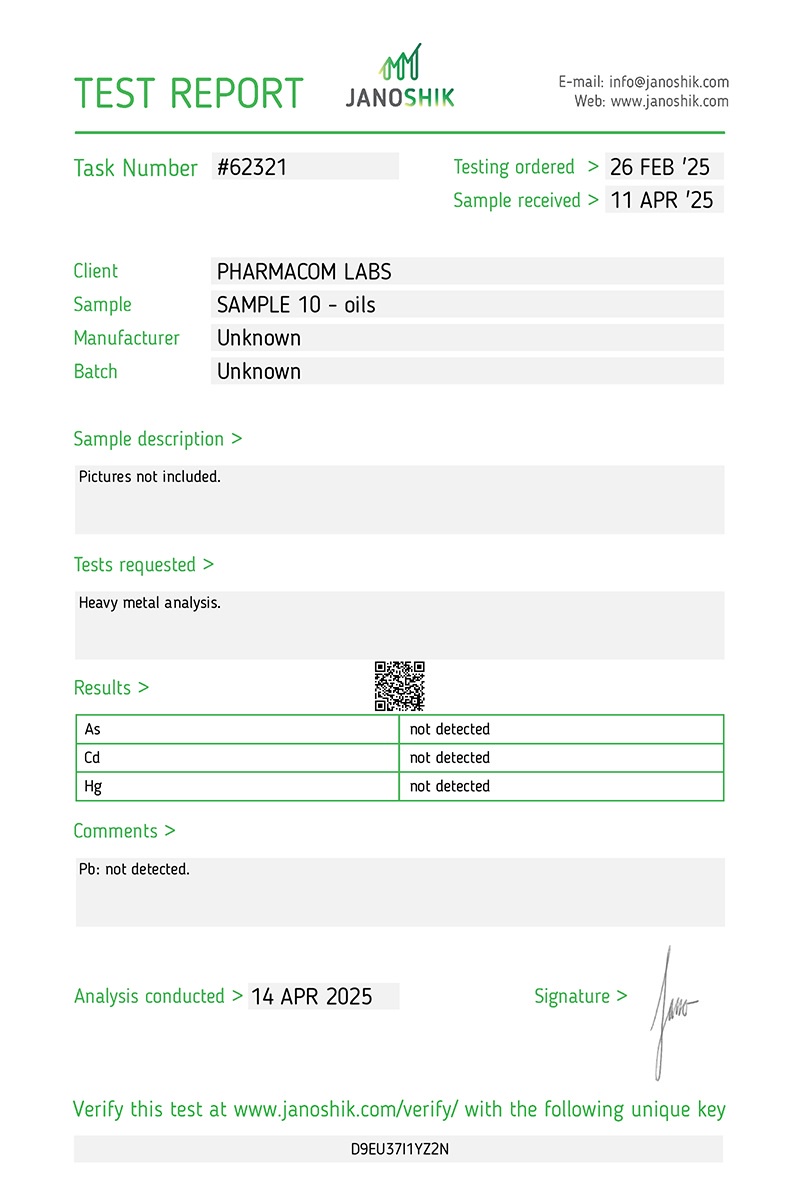
Heavy Metal Analysis:
CBy34lK.jpg

  • As: not detected.
  • Cd: not detected.
  • Hg: not detected.
  • Pb: not detected.
Analysis conducted: 14 April 2025.
 
SB Labs
PHARMA PRIM 100: Primobolan Enanthate 100 from Pharmacom Labs

Analytic testing performed by Janoshik.

RESULTS:
nWFsUC7.jpeg

1. Qualitative analysis: the sample contains the active ingredient Methenolone Enanthate.
2. Quantitative analysis showed the content of active ingredient: 100.88 mg/mL.

Analysis conducted: 13 April 2025
 
  • Like
Reactions: Vee
OXANDROLONOS: Oxandrolone (Anavar) 10 from Pharmacom Labs

Analytic testing performed by Janoshik.

RESULTS:
ON34HLe.jpeg

1. Qualitative analysis: the sample contains the active ingredient Oxandrolone.
2. Quantitative analysis showed the content of active ingredient: 10.08 mg.

Analysis conducted: 14 April 2025
 
Recent discussions about analytic results lead me to do some AI searches about USP/FDA potency standards because someone a little while ago said he does not accept the well-known +/- 10% standard. I think a lot of people don't even realize that big official licensed companies follow this FDA +/- 10% standard, and compound pharmacies may even follow a +/- 5% to +/-20% standard in some cases.

Also, keep in mind that analytic testing results have an error range of their own and are a process run by humans, on machines humans built, using standards humans prepared; like with anything else, humans are not perfect so there are always possibilities or errors and inconsistencies in any process.
Two analytic samples from the same exact batch may give slightly different results because the testing procedure itself has some variance.

Therefore, if we consider the possible variance in production potency (+/- 10%, maybe even +/- 5% to +/- 20%) with the possible variance in the analytic results, the error may compound and give values that people freak out about (because they may not understand, are ignorant, or just emotional and dramatic).

Overall, it seems that steroid forum communities do not really understand these details and have developed some unrealistic expectations regarding analytic results.

Please see my next post for the results of my searches and inquiries about FDA and USP potency standards.
 
US FDA and USP Potency Standards.

FDA-approved medications generally must contain active ingredients within +/- 10% of the labeled amount. For compounded preparations, the typical acceptable range is also +/- 10%, with a maximum, in some cases, of up to +/- 20%.

Based on United States Pharmacopeia (USP) standards, which guide pharmacy compounding practices, the information provided is generally accurate. [1, 2, 3]

Compounded Preparations (USP 795 & 797)
• Typical Range: The standard acceptable variability in potency for most compounded nonsterile (USP 795) and sterile (USP 797) preparations is +/- 10% of the labeled strength.
• Maximum Range: Depending on the stability of the ingredient, the specific dosage form, or if the ingredient is complex (such as some proteins), the acceptable range can extend up to +/- 20%.
• Other Ranges: For certain raw powders, potency requirements may be as tight as +/- 2%, while for others it may differ. [5, 6]
FDA-Approved Medications
• General Standards: FDA-approved manufactured drugs must adhere to strict stability and potency standards, typically requiring active ingredients to be within 90%–110% (+/- 10%) of the labeled amount, though some specific drug monographs may differ. [7, 8, 9, 10, 11]
Key Differences
• Compounded Drugs: Are not FDA-approved, meaning the FDA does not evaluate their safety, effectiveness, or quality before they are marketed, although they must be made using specific USP guidelines.
• Acceptable Variability: Because they are made one at a time to individual prescriptions, compounded drugs often have a slightly wider permitted variance (sometimes up to +/- 20%) compared to the strict, consistent manufacturing requirements of FDA-approved drugs. [6, 12, 13, 14, 15]

[1] Understanding Compounding Pharmacies: Requirements and Services
[2] What Is Liquid Medicine From Compounding Pharmacies? - Burt's
[3] Understanding Reference and Working Standards in Pharmaceuticals | farnamshime tajhiz posted on the topic | LinkedIn
[4] ARL Bio Pharma | Labeling Compounded Preparations
[5] THE PCCA BLOG | Notable Changes in the New USP <795>
[6] https://www.arlok.com/sites/default...797 for Compounded Sterile Preparations_0.pdf
[7] https://www.pharmacy.texas.gov/files_pdf/BN/Nov21/D.1.3.pdf
[8] The Scientist’s Guide to Understanding FDA Drug Approval
[9] Compounded Bioidentical Hormone Preparations - The Clinical Utility of Compounded Bioidentical Hormone Therapy - NCBI Bookshelf
[10] Compounding Pharmacies: The Top 5 Questions | Sona Pharmacy + Clinic
[11] Study: Expiration dates have nothing to do with shelf life of drugs
[12] Human Drug Compounding Laws
[13] What Ingredients Can Be Used in Compounded Drugs?
[14] https://www.goodrx.com/drugs/medication-basics/compound-medications
[15] Comparison of three automated compounding devices for parenteral nutrition according to four key technical tests - PMC


The United States Pharmacopeia (USP) establishes that the generally accepted potency range for most compounded and manufactured drug preparations is +/- 10% of the labeled amount, though this can vary from +/- 5% to +/- 20% depending on the specific monograph. These standards, often cited in FDA guidance and 21 CFR 211.192, ensure drug quality, purity, and potency. [1, 2, 3]

Key details regarding USP/FDA potency requirements:
• Standard Range: The common, accepted potency range is 90% –110% (+/- 10%) of the label claim.
• Variations: Potency requirements may be stricter (+/- 5% for potent analgesics) or wider (+/- 20% for some proteins) based on specific USP monographs.
• Regulatory Context: FDA 21 CFR 211.192 requires investigation of any batch that fails to meet these established specifications.
• Compounding: USP 795 & USP 797 standards for compounded preparations frequently reference the +/- 10% tolerance. [1, 2, 4, 5, 6]

[1] 21 CFR 211.192 Production Record Review - Performance Validation
[2] ARL Bio Pharma | Potency Testing Benefits and Requirements
[3] What the Letters "USP" Mean on the Label of Your Medicine | Quality Matters | U.S. Pharmacopeia Blog
[4] Strength Conversion in Drug Listing
[5] Compounding with Commercial Drugs Can Cause Errors | Pharmacy Times
[6] https://www.usp.org/sites/default/f...stability-testing-compounded-preparations.pdf

(NOTE: these are AI search and inquiry results, not my original work).
 
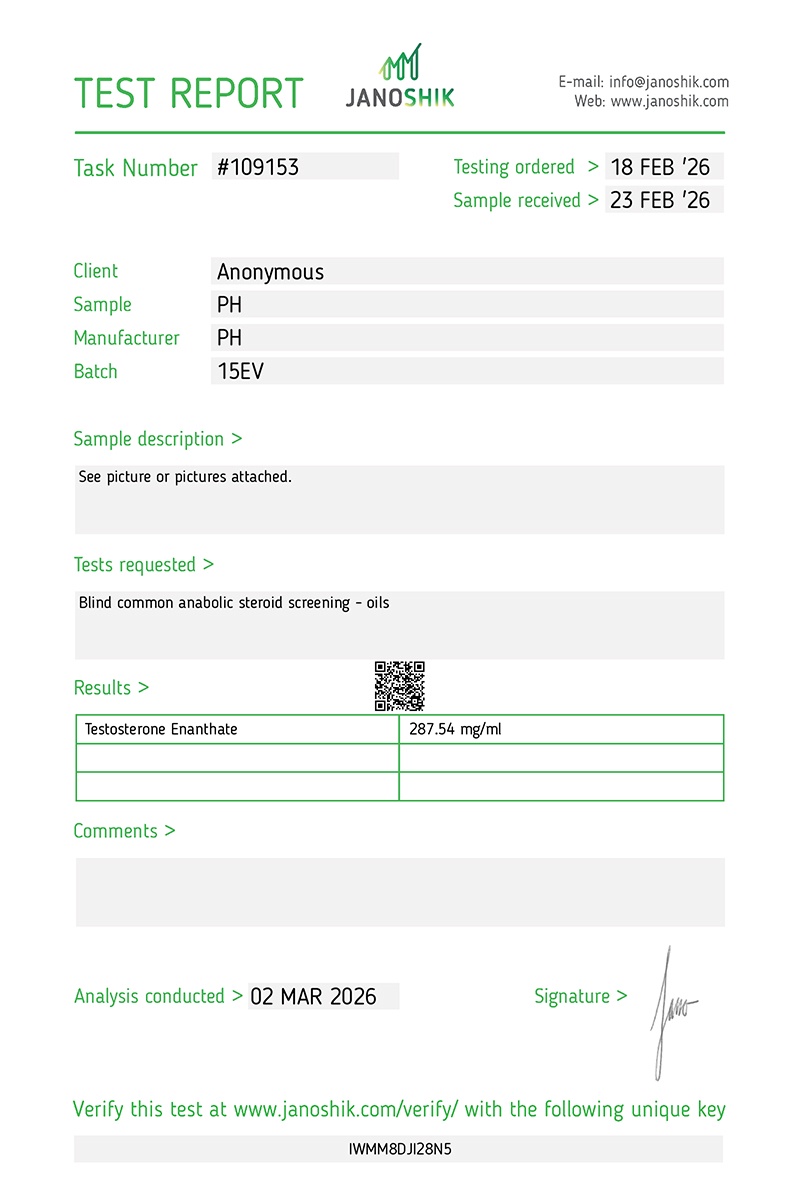
PHARMA TEST E300: Testosterone Enanthate 300 from Pharmacom Labs

Analytic testing performed by Janoshik.

RESULTS:
AKHbZVU.jpeg

1. Qualitative analysis: the sample contains the active ingredient Testosterone Enanthate.
2. Quantitative analysis showed the content of active ingredient: 287.54 mg/mL.

Analysis conducted: 02 March 2026.
 
Status
Not open for further replies.

Latest threads

Back
Top