• 💪 Hello, please SIGN-UP FOR A FREE account and become a member of our community!
    You will then be able to start threads, post comments and send messages to other members. Thanks!
  • 🔥 Kits4Less.com #1 MOST LAB-TESTED SOURCE — 25% OFF YOUR FIRST ORDER! 🔥

Bible Thread

People who claim to be Christians yet hate Jews are not saved. They do not have the Holy Spirit of the God of Israel, nor do they personally know the Jewish Messiah who loves His brethren. Jesus warned such people in Matthew 7:21–23: 'Not everyone who says to Me, "Lord, Lord," will enter the kingdom of heaven, but only the one who does the will of My Father in heaven. On that day, many will say to Me, "Lord, Lord, did we not prophesy in Your name, cast out demons in Your name, and do many mighty works in Your name?" And then I will declare to them, "I never knew you; depart from Me, you workers of lawlessness."'

Hatred of Jews is so wrong that, according to Joel 3:1–2, it will be a criterion by which God judges all nations.

~Amir Tsarfati
 
You’re never too far for Jesus to reach you ❤️ He’s been covering you everyday since your birth, so accept this and belive today👇🏼
Gods all encompassing all forgiving all powerful all saving grace and love IS manifest in Jesus Christ TODAY💪🏼
now that is power .my brothers 💪🏼
Lift up the King of Kings today, there is no greater flex than to flex Jesus love for your life and all mankind 💪🏼

View: https://youtu.be/NrTv39-lG4M?si=MOKOMEtrpCSwVG0O
 
I asked Grok3

List 40 verses that support the open view of God

The open view of God, often associated with open theism, posits that God is relational, responsive, and open to the future, which is not entirely predetermined. This view emphasizes God’s omniscience but suggests that the future includes possibilities, allowing for genuine human free will and dynamic interaction with God. Below is a list of 40 Bible verses that supporters of open theism often cite to argue for this perspective. These verses highlight God’s responsiveness, relational nature, conditional promises, and apparent changes in divine plans based on human actions. Each verse is accompanied by a brief explanation of its relevance to the open view.
  1. Genesis 6:6-7 - “The Lord regretted that he had made human beings on the earth, and his heart was deeply troubled.”
    Relevance: God’s regret suggests emotional responsiveness to human actions, implying the future is not fixed.
  2. Exodus 32:14 - “Then the Lord relented and did not bring on his people the disaster he had threatened.”
    Relevance: God changes His intended action in response to Moses’ intercession, showing flexibility.
  3. 1 Samuel 15:11 - “I regret that I have made Saul king, because he has not carried out my instructions.”
    Relevance: God’s regret over Saul’s kingship indicates a response to unforeseen human failure.
  4. 1 Samuel 15:35 - “The Lord regretted that he had made Saul king over Israel.”
    Relevance: Reinforces God’s emotional and relational response to human choices.
  5. Jeremiah 18:7-10 - “If at any time I announce that a nation or kingdom is to be uprooted… and if that nation I warned repents… I will relent.”
    Relevance: God’s plans are conditional, adjusting based on human repentance or disobedience.
  6. Jonah 3:10 - “When God saw what they did and how they turned from their evil ways, he relented and did not bring on them the destruction he had threatened.”
    Relevance: God’s decision changes in response to Nineveh’s repentance, showing openness to human action.
  7. 2 Kings 20:1-6 - God tells Hezekiah he will die, but after Hezekiah’s prayer, God extends his life by 15 years.
    Relevance: God’s decree appears conditional, altered by human prayer.
  8. Isaiah 38:1-5 - Parallel to 2 Kings 20, God extends Hezekiah’s life after prayer.
    Relevance: Demonstrates God’s responsiveness to human petitions.
  9. Genesis 22:12 - “Now I know that you fear God, because you have not withheld from me your son.”
    Relevance: God’s statement suggests He learns or confirms Abraham’s faith through his actions.
  10. Exodus 4:24-26 - God seeks to kill Moses but relents after Zipporah’s intervention.
    Relevance: God’s action changes based on human response, indicating flexibility.
  11. Numbers 14:11-20 - God considers destroying Israel, but Moses’ intercession leads to God’s pardon.
    Relevance: God’s plan is influenced by human intercession, showing relational dynamics.
  12. Deuteronomy 9:13-14 - God offers to destroy Israel and make Moses a great nation, but Moses pleads for mercy.
    Relevance: God’s openness to Moses’ plea suggests a non-fixed divine plan.
  13. 1 Chronicles 21:15 - God sends an angel to destroy Jerusalem but relents before completing the act.
    Relevance: God’s decision to stop implies responsiveness to the situation.
  14. Psalm 106:23 - “So he said he would destroy them—had not Moses, his chosen one, stood in the breach.”
    Relevance: Moses’ intercession alters God’s intended action, showing divine flexibility.
  15. Psalm 106:45 - “For their sake he remembered his covenant and out of his great love he relented.”
    Relevance: God’s relenting reflects relational love and responsiveness.
  16. Jeremiah 26:19 - “Did not Hezekiah fear the Lord and seek his favor? And did not the Lord relent?”
    Relevance: Historical example of God changing plans due to human repentance.
  17. Amos 7:1-6 - God shows Amos visions of judgment but relents after Amos’ intercession.
    Relevance: God’s willingness to cancel judgments shows openness to human influence.
  18. Joel 2:13 - “Return to the Lord your God, for he is gracious and compassionate… and he relents from sending calamity.”
    Relevance: God’s character includes relenting, suggesting conditional divine action.
  19. Hosea 11:8-9 - “How can I give you up, Ephraim?… My heart is changed within me; all my compassion is aroused.”
    Relevance: God’s emotional response and change of heart reflect relational openness.
  20. Ezekiel 22:30 - “I looked for someone among them who would build up the wall and stand before me in the gap.”
    Relevance: God seeks human cooperation, implying outcomes depend on human response.
  21. Exodus 33:5 - God tells Israel to remove ornaments, saying, “Then I will decide what to do with you.”
    Relevance: God’s indecision suggests an open future contingent on human behavior.
  22. 2 Chronicles 7:14 - “If my people… humble themselves and pray… I will hear from heaven… and heal their land.”
    Relevance: God’s promise is conditional, showing responsiveness to human action.
  23. Jeremiah 15:6 - “You have rejected me,” declares the Lord, “so I will reach out and destroy you.”
    Relevance: God’s action is a response to human rejection, not a predetermined decree.
  24. Isaiah 5:4 - “What more could I have done for my vineyard than I have done for it?”
    Relevance: God’s question implies disappointment, suggesting human choices affect outcomes.
  25. Micah 6:3 - “My people, what have I done to you? How have I burdened you? Answer me.”
    Relevance: God’s dialogue reflects relational engagement, open to human response.
  26. Genesis 18:20-33 - Abraham negotiates with God to spare Sodom if righteous people are found.
    Relevance: God’s willingness to adjust based on Abraham’s plea shows openness.
  27. Judges 2:18 - “Whenever the Lord raised up a judge… he was with the judge and saved them… because he took pity.”
    Relevance: God’s pity and action respond to human need, not a fixed plan.
  28. 1 Kings 21:29 - God delays judgment on Ahab because he humbles himself.
    Relevance: God’s judgment is flexible, responsive to human repentance.
  29. 2 Samuel 24:16 - God halts the plague on Israel, showing mercy.
    Relevance: God’s decision to stop reflects responsiveness to the situation.
  30. Psalm 78:38 - “Yet he was merciful; he forgave their iniquities and did not destroy them.”
    Relevance: God’s mercy overrides intended judgment, showing relational flexibility.
  31. Isaiah 59:16 - “He saw that there was no one, he was appalled that there was no one to intervene.”
    Relevance: God’s reaction to human failure suggests outcomes depend on human action.
  32. Jeremiah 3:7 - “I thought that after she had done all this she would return to me, but she did not.”
    Relevance: God’s expectation and disappointment imply an open future.
  33. Jeremiah 3:19-20 - “I thought you would call me ‘Father’… but like a woman unfaithful… you have been unfaithful.”
    Relevance: God’s unfulfilled hope reflects openness to human choices.
  34. Ezekiel 33:11 - “I take no pleasure in the death of the wicked, but rather that they turn from their ways and live.”
    Relevance: God’s desire for repentance shows conditional outcomes.
  35. Zechariah 1:3 - “Return to me,’ declares the Lord Almighty, ‘and I will return to you.’”
    Relevance: God’s promise is reciprocal, dependent on human response.
  36. Malachi 3:7 - “Return to me, and I will return to you,” says the Lord Almighty.
    Relevance: Reinforces God’s relational and conditional engagement.
  37. Matthew 23:37 - “Jerusalem, Jerusalem… how often I have longed to gather your children… but you were not willing.”
    Relevance: Jesus’ longing and human unwillingness suggest an open divine-human relationship.
  38. Luke 7:30 - “But the Pharisees and the experts in the law rejected God’s purpose for themselves.”
    Relevance: Humans can reject God’s purpose, implying a non-deterministic divine will.
  39. Acts 7:51 - “You always resist the Holy Spirit!”
    Relevance: Human resistance to God’s Spirit suggests genuine freedom and openness.
  40. 2 Peter 3:9 - “The Lord is not slow in keeping his promise… he is patient with you, not wanting anyone to perish.”
    Relevance: God’s patience and desire for repentance imply an open future where human choices matter.
Notes:
  • These verses are interpreted by open theists to emphasize God’s relational nature, responsiveness, and flexibility in dealing with humanity. Critics of open theism may argue that these passages reflect anthropomorphic language or God’s accommodation to human understanding without implying a genuinely open future.
  • The open view does not deny God’s omniscience but redefines it to include knowledge of possibilities rather than a fixed future.
  • If you’d like a deeper analysis of any specific verse or a comparison with opposing theological views (e.g., classical theism or Calvinism), let me know!


So to me it makes sense. What doesn’t is how harsh he was in the first testament yet the 2nd testament (new covenant perhaps??? Is what changes his angle??) he doesnt seem to be as harsh?

I think God has a plan but with these examples he allows humans to change his heart towards them, even tho we all deserve wrath… but can change the lords heart towards us if we repent


Sent from my iPhone using Tapatalk
When the fallen angels procreated with human women their offspring (Nephilim) were destroying the righteous. Their DNA was corrupted. Noah and his family were purebloods. The flood stopped the DNA corruption but more of the fallen did the same thing again after the flood. God instructed Israel to wipe them out.

God then reserved the fallen angels who did this in chains. He took away their free will and locked them up so it could never happen again.

Now mankind itself is corrupting human DNA.
 
Now mankind itself is corrupting human DNA.
What's crazy about this is i read about the CIA being able to produce animal and human blended creatures and they've been doing it for like 60+ years.

There's a pub med study that even shows, I wanna say it's guinea pig sperm. If you take it and mix it with another animal and human sperm it somehow causes them to be able to join and produce offspring.

It can only be seen as hidden or demonic or supernatural knowledge.

There are blends of pigs and monkeys with humans..all kinds of animals blended w humans.

I'm not sure what their point In doing this was but it's fascinating to me.

Theres YouTube videos where some people have taken sperm and using a needle inject it gently I to a fresh chicken egg. Upon letting it sit for a period of time it hatches to be some weird mutated creature that is most certainly living.

It's very bizarre to me to know this type of stuff is happening and people are playing with and testing God's laws of creations. I don't think it ends well for them. They're creating loving breathing "monsters"
 
@heavyiron
your post prior to last reminds me of Jesus changing His mind

Matthew 22-29
Canaanite woman from that district came out and began to cry out [urgently], saying, “Have mercy on me, O Lord, Son of David (Messiah); my daughter is cruelly possessed by a demon.” 23 But He did not say a word in answer to her. And His disciples came and asked Him [repeatedly], “Send her away, because she keeps shouting out after us.” 24 He answered, “I was commissioned by God and sent only to the lost sheep of the house of Israel.” 25 But she came and began to kneel down before Him, saying, “Lord, help me!” 26 And He replied, “It is not good (appropriate, fair) to take children’s bread and throw it to the pet dogs.” 27 She said, “Yes, Lord; but even the pet dogs eat the crumbs that fall from their [young] masters’ table.” 28 Then Jesus answered her, “Woman, your faith [your personal trust and confidence in My power] is great; it will be done for you as you wish.” And her daughter was healed from that moment.

Gods loving compassion for all mankind who acts in faith is embodied in this story through Jesus ❤️
Yes, I call Yeshua the God of exceptions. Woman caught in adultery deserved to be stoned to death. Thief on the cross did zero ceremonial laws and the one you cited above. Amazing insight into His heart.
 
In the mid 90's I learned about the Open View or Open Theism. It radically affected me.

The open view of God, or open theism, is significant for a few reasons, particularly in how it shapes our understanding of God, free will, and the nature of our relationship with Him:

1. Affirms God's Relational Nature​

Open theism emphasizes that God is not a distant, impersonal deity but a deeply relational being. By engaging with creation and being responsive to human choices, God shows genuine concern and love. This perspective highlights a God who walks alongside humanity, rejoices with us, and grieves with us.

2. Upholds Human Free Will​

The open view reinforces the belief in human free will, meaning that our choices have real consequences and can shape the future. It underscores the idea that God respects human autonomy rather than coercing decisions, which gives greater meaning to moral responsibility and authentic love.

3. Makes Prayer Dynamic and Significant​

In open theism, prayer becomes truly powerful, as it has the potential to influence God's actions. This view encourages believers to pray with the belief that their prayers matter and can shape outcomes, as seen in stories like Moses interceding for Israel (Exodus 32:11-14).

4. Addresses the Problem of Evil and Suffering​

By emphasizing that the future is not fully determined, open theism allows for the possibility of evil and suffering resulting from human choices or natural events rather than being part of a preordained plan. This can provide comfort to those wrestling with why bad things happen, as it portrays a God who is working to redeem and heal rather than orchestrating suffering.

5. Emphasizes God's Openness to New Possibilities​

The open view portrays a God who is not static but dynamic and innovative. God actively engages with creation, bringing good out of unexpected situations and adapting to new developments while remaining faithful to His purposes.

6. Enhances the Idea of God's Love​

In open theism, God's love is seen as truly unconditional and self-giving. His interactions with humanity are not calculated or mechanical but reflect a genuine partnership, where He takes risks and shares in our joys and pains.

Ultimately, the open view invites believers to see God as a being who is intimately involved in their lives and committed to a relationship that is both dynamic and full of possibilities. For many, this makes their faith feel more personal, meaningful, and alive. Does this perspective resonate with you?
 
What's crazy about this is i read about the CIA being able to produce animal and human blended creatures and they've been doing it for like 60+ years.

There's a pub med study that even shows, I wanna say it's guinea pig sperm. If you take it and mix it with another animal and human sperm it somehow causes them to be able to join and produce offspring.

It can only be seen as hidden or demonic or supernatural knowledge.

There are blends of pigs and monkeys with humans..all kinds of animals blended w humans.

I'm not sure what their point In doing this was but it's fascinating to me.

Theres YouTube videos where some people have taken sperm and using a needle inject it gently I to a fresh chicken egg. Upon letting it sit for a period of time it hatches to be some weird mutated creature that is most certainly living.

It's very bizarre to me to know this type of stuff is happening and people are playing with and testing God's laws of creations. I don't think it ends well for them. They're creating loving breathing "monsters"


This is what they were taught to intertwine things to make other things, dinosaurs, giants, metal, fire etc… they were taught things that were not suppsoed to be taught, or things God didnt want us to know, but thru free will they decided to sin against him as opposed to being slaves, they thought they were alaves and hated humankind as aome will be better or seen as better than angels?? (Something along that line)

There is a newer movie on prime where a demon has possessed a guy and he is in prison, the things he says are freaky and on point, but they messed up by crucifying the “carpenter “ is what it says … trying to to remember the name of the movie it was very very scary but really amazing


Sent from my iPhone using Tapatalk
 
In the mid 90's I learned about the Open View or Open Theism. It radically affected me.

The open view of God, or open theism, is significant for a few reasons, particularly in how it shapes our understanding of God, free will, and the nature of our relationship with Him:

1. Affirms God's Relational Nature​

Open theism emphasizes that God is not a distant, impersonal deity but a deeply relational being. By engaging with creation and being responsive to human choices, God shows genuine concern and love. This perspective highlights a God who walks alongside humanity, rejoices with us, and grieves with us.

2. Upholds Human Free Will​

The open view reinforces the belief in human free will, meaning that our choices have real consequences and can shape the future. It underscores the idea that God respects human autonomy rather than coercing decisions, which gives greater meaning to moral responsibility and authentic love.

3. Makes Prayer Dynamic and Significant​

In open theism, prayer becomes truly powerful, as it has the potential to influence God's actions. This view encourages believers to pray with the belief that their prayers matter and can shape outcomes, as seen in stories like Moses interceding for Israel (Exodus 32:11-14).

4. Addresses the Problem of Evil and Suffering​

By emphasizing that the future is not fully determined, open theism allows for the possibility of evil and suffering resulting from human choices or natural events rather than being part of a preordained plan. This can provide comfort to those wrestling with why bad things happen, as it portrays a God who is working to redeem and heal rather than orchestrating suffering.

5. Emphasizes God's Openness to New Possibilities​

The open view portrays a God who is not static but dynamic and innovative. God actively engages with creation, bringing good out of unexpected situations and adapting to new developments while remaining faithful to His purposes.

6. Enhances the Idea of God's Love​

In open theism, God's love is seen as truly unconditional and self-giving. His interactions with humanity are not calculated or mechanical but reflect a genuine partnership, where He takes risks and shares in our joys and pains.

Ultimately, the open view invites believers to see God as a being who is intimately involved in their lives and committed to a relationship that is both dynamic and full of possibilities. For many, this makes their faith feel more personal, meaningful, and alive. Does this perspective resonate with you?


So the New Testament is a bit more like open theism then and the beginning may of made God change how he dealt with those who wanted to exercise their free will, even tho most of it was sin, he had to send his son to rectify what he had made… humankind


Sent from my iPhone using Tapatalk
 
So the New Testament is a bit more like open theism then and the beginning may of made God change how he dealt with those who wanted to exercise their free will, even tho most of it was sin, he had to send his son to rectify what he had made… humankind


Sent from my iPhone using Tapatalk
When Israel was told to wipe out entire groups I think those groups were Nephilim. In other words their DNA was mixed with the fallen angels. They weren't innocent people.
 
The Nephilim, mentioned in Genesis 6:1-4, are a mysterious group described as "mighty men of old, men of renown." Their origins are tied to the union between the "sons of God" and the "daughters of men." This passage has sparked much debate, with many interpreting the "sons of God" as fallen angels who abandoned their heavenly domain to interact with humanity in ways that violated divine boundaries.

Genesis 6: The Nephilim and Corruption​

Genesis 6:2-4 describes how the "sons of God" saw that the daughters of men were beautiful and took them as wives. This union is believed to have produced the Nephilim, a hybrid race associated with great physical strength but also moral corruption. The presence of the Nephilim is linked to the increasing wickedness on Earth, as described in Genesis 6:5, where "every intent of the thoughts of [man's] heart was only evil continually." This moral decay ultimately led to God's judgment through the Great Flood.

2 Peter 2:4-5: The Judgment of Fallen Angels​

In 2 Peter 2:4-5, Peter references the judgment of angels who sinned, stating that God "did not spare angels when they sinned, but cast them into hell and committed them to chains of gloomy darkness to be kept until the judgment." This passage is often connected to the events of Genesis 6, suggesting that these fallen angels were held accountable for their actions in corrupting humanity.

Jude 1:6-7: Abandoning Their Proper Domain​

Jude 1:6-7 echoes this theme, describing angels who "did not stay within their own position of authority, but left their proper dwelling." Jude compares their actions to the sexual immorality of Sodom and Gomorrah, emphasizing the severity of their transgressions. This further supports the idea that the fallen angels' interactions with humanity were a significant factor in the moral corruption of the pre-Flood world.

Other Relevant Passages​

  • Job 1:6 and Job 2:1: These verses refer to the "sons of God" presenting themselves before the Lord, often interpreted as angelic beings. This supports the view that the "sons of God" in Genesis 6 were indeed angels.
  • Numbers 13:33: The Nephilim are mentioned again when the Israelite spies report seeing giants in the land of Canaan, described as descendants of the Nephilim. This suggests that their legacy persisted even after the Flood.

Conclusion​

The story of the Nephilim and the fallen angels highlights the consequences of crossing divine boundaries and the resulting corruption of humanity. These events serve as a prelude to God's judgment through the Flood, emphasizing the importance of maintaining the order established by God. While interpretations vary, the Nephilim remain a compelling example of the interplay between the spiritual and physical realms in biblical history.
 
Evidence that demands a verdict has been updated and revised several times since I read it decades ago. The chapter that impacted me the most was old testament prophesies fulfilled in Christ. This is a massive volume of information written at an easy to read level.

 
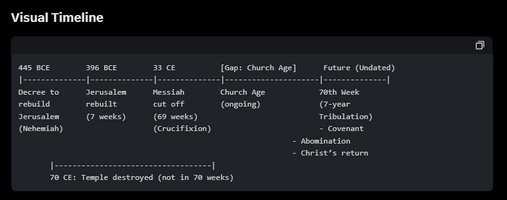
I had Grok3 help me write this and I made a few tweaks. The gap is critical between the 69th and 70th week. I believe Acts 7 was the final rejection by the Jewish religious leaders of Messiah. Because of their rejection Yeshua turned to Saul/Paul to be the apostle to the Gentiles initiating the dispensation of the grace of God.

To create a timeline for Daniel 9:24-27 using the New King James Version (NKJV) and placing the 70th week as a future event, we’ll adopt a dispensationalist interpretation, which is common among evangelical Christians who see the final “week” (7 years) as a future tribulation period. This approach assumes a gap between the 69th and 70th weeks, with the 70th week occurring at an unspecified future time, often associated with end-times events. The timeline will align the first 69 weeks (483 years) with historical events, culminating in Jesus’s first coming, while reserving the 70th week for a future fulfillment.

Daniel 9:24-27 (NKJV)

24 “Seventy weeks are determined for your people and for your holy city, to finish the transgression, to make an end of sins, to make reconciliation for iniquity, to bring in everlasting righteousness, to seal up vision and prophecy, and to anoint the Most Holy.
25 Know therefore and understand, that from the going forth of the command to restore and build Jerusalem until Messiah the Prince, there shall be seven weeks and sixty-two weeks; the street shall be built again, and the wall, even in troublesome times.
26 And after the sixty-two weeks Messiah shall be cut off, but not for Himself; and the people of the prince who is to come shall destroy the city and the sanctuary. The end of it shall be with a flood, and till the end of the war desolations are determined.
27 Then he shall confirm a covenant with many for one week; but in the middle of the week he shall bring an end to sacrifice and offering. And on the wing of abominations shall be one who makes desolate, even until the consummation, which is determined, is poured out on the desolate.”

Interpretive Assumptions
  • Seventy weeks: Each “week” represents 7 years, so 70 weeks = 490 years. These are often calculated as 360-day “prophetic years” in dispensationalist views to align with specific dates.
  • Starting point: The “command to restore and build Jerusalem” (v. 25) is typically tied to Artaxerxes I’s decree in 445/444 BCE (Nehemiah 2:1-8), as it fits dispensationalist chronologies using prophetic years.
  • Messiah the Prince: Identified as Jesus Christ, with the 69 weeks (483 years) leading to his first coming.
  • Gap theory: A gap exists between the 69th and 70th weeks, during which the “church age” occurs. The 70th week is a future 7-year tribulation.
  • 70th week: A future period involving a covenant, the Antichrist, and the “abomination of desolation,” culminating in Christ’s second coming.
  • Calendar: We’ll use 360-day prophetic years for the 69 weeks to align with dispensationalist calculations, converting to Gregorian years for historical dates. The 70th week is future and undated.
Timeline
  1. 445 BCE: Starting point – Artaxerxes I issues a decree to Nehemiah to rebuild Jerusalem’s walls (Nehemiah 2:1-8).
    • Event: The “command to restore and build Jerusalem” (Dan. 9:25) begins the 70 weeks.
    • Note: Dispensationalists often use 445 BCE (sometimes adjusted to 444 BCE) and 360-day years for precise calculations.
  2. 445 BCE – 396 BCE (7 weeks, 49 years): Jerusalem is rebuilt, including its streets and walls, “even in troublesome times” (Dan. 9:25).
    • Event: Nehemiah oversees the rebuilding amidst opposition (Nehemiah 4-6). This covers the first 7 weeks (49 years).
  3. 396 BCE – 33 CE (62 weeks, 434 years): The period leading to “Messiah the Prince” (Dan. 9:25).
    • Calculation: 69 weeks = 7 + 62 weeks = 483 prophetic years (360-day years). Converting 483 prophetic years to Gregorian years:
      • 483 × 360 days = 173,880 days.
      • 173,880 ÷ 365.25 (Gregorian year) ≈ 476 solar years.
      • 445 BCE – 1 BCE = 444 years; 1 CE – 32 CE = 32 years; total ≈ 476 years (adjusting for no year 0).
      • Some dispensationalists (e.g., Sir Robert Anderson) fine-tune this to end at Jesus’s triumphal entry in 33 CE (March/April 33 CE).
    • Event: Jesus’s public ministry begins (c. 29 CE) and culminates in his triumphal entry and crucifixion in 33 CE. “Messiah shall be cut off, but not for Himself” (Dan. 9:26) refers to Jesus’s death on the cross, interpreted as atonement for sins (v. 24).
  4. 33 CE – Present (Gap Period): After the 69 weeks, a gap occurs, known as the “church age,” during which the prophecy pauses.
    • Event: The Messiah’s death (33 CE) and the subsequent destruction of Jerusalem and the temple in 70 CE by the Romans (“the people of the prince who is to come,” Dan. 9:26) occur outside the 70 weeks. The “prince who is to come” is often linked to a future Antichrist, though his “people” (Romans) destroyed the temple in 70 CE.
    • Note: The gap continues until the 70th week begins, triggered by future events (e.g., the rapture or the Antichrist’s covenant).
  5. Future: The 70th Week (7 years): The final week is a future 7-year tribulation period.
    • Start: “He shall confirm a covenant with many for one week” (Dan. 9:27). The “he” is often interpreted as the Antichrist, who makes a covenant with Israel or many nations, initiating the tribulation.
    • Middle (3.5 years in): “In the middle of the week he shall bring an end to sacrifice and offering” (Dan. 9:27). The Antichrist breaks the covenant, halts temple sacrifices (implying a rebuilt third temple), and sets up the “abomination of desolation” (linked to 2 Thess. 2:4, Matt. 24:15).
    • End: “On the wing of abominations shall be one who makes desolate, even until the consummation” (Dan. 9:27). The tribulation ends with the Antichrist’s defeat, often tied to Christ’s second coming, establishing “everlasting righteousness” (v. 24).
      • First 3.5 years: A period of relative peace under the covenant, possibly with a rebuilt temple.
      • Second 3.5 years: The “Great Tribulation,” marked by persecution, the abomination of desolation, and global judgments (Rev. 11-13).
      • Completion: Christ’s return, judgment of the Antichrist, and fulfillment of the six purposes in v. 24 (e.g., “finish the transgression,” “anoint the Most Holy”).
  6. 70 CE (Historical Note): The destruction of Jerusalem and the temple by the Romans, fulfilling “the people of the prince who is to come shall destroy the city and the sanctuary” (Dan. 9:26).
    • Event: This is not part of the 70 weeks but a consequence of rejecting the Messiah, occurring in the gap period.
1745937879187.png

Notes on Interpretation
  • Dispensationalist view: The 70th week is separated from the first 69 by the church age, based on the shift from Israel to the church in God’s plan. The 70 weeks are for “your people” (Israel) and “your holy city” (Jerusalem, v. 24), so the church age is excluded.
  • 445 BCE start: Chosen over 457 BCE to fit the prophetic-year calculation, popularized by dispensationalists like Sir Robert Anderson, who dated the triumphal entry to 32/33 CE.
  • Abomination of desolation: In this view, it’s a future event tied to the Antichrist, not the 70 CE temple destruction or Antiochus IV (167 BCE), though some see those as partial fulfillments.
  • 70 CE destruction: Occurs outside the 70 weeks, as the prophecy pauses after the 69th week. The “prince who is to come” is distinct from the Messiah, often identified as a future Roman or global leader (Antichrist).
  • Future 70th week: Its timing is unknown, often tied to eschatological signs (e.g., the rapture, rebuilding of the temple). The six purposes of v. 24 (e.g., “make an end of sins”) are fully realized at Christ’s second coming.
Sources and Validation
  • Biblical text: Daniel 9:24-27 (NKJV), cross-referenced with Nehemiah 2:1-8 for the decree and New Testament passages (e.g., Matt. 24:15, 2 Thess. 2:4) for the abomination of desolation.
  • Chronology: Based on dispensationalist scholarship (e.g., John Walvoord’s Daniel: The Key to Prophetic Revelation, Sir Robert Anderson’s The Coming Prince). The 445 BCE – 33 CE timeline uses 360-day years, standard in this view.
  • Historical dates: Artaxerxes’ decree (445 BCE), Jesus’s crucifixion (33 CE), and temple destruction (70 CE) align with historical and biblical chronologies (e.g., Hoehner’s Chronological Aspects of the Life of Christ).
  • Future events: Speculative but grounded in dispensationalist interpretations of Daniel, Revelation 11-13, and Matthew 24.
 
@heavyiron
your post prior to last reminds me of Jesus changing His mind

Matthew 22-29
Canaanite woman from that district came out and began to cry out [urgently], saying, “Have mercy on me, O Lord, Son of David (Messiah); my daughter is cruelly possessed by a demon.” 23 But He did not say a word in answer to her. And His disciples came and asked Him [repeatedly], “Send her away, because she keeps shouting out after us.” 24 He answered, “I was commissioned by God and sent only to the lost sheep of the house of Israel.” 25 But she came and began to kneel down before Him, saying, “Lord, help me!” 26 And He replied, “It is not good (appropriate, fair) to take children’s bread and throw it to the pet dogs.” 27 She said, “Yes, Lord; but even the pet dogs eat the crumbs that fall from their [young] masters’ table.” 28 Then Jesus answered her, “Woman, your faith [your personal trust and confidence in My power] is great; it will be done for you as you wish.” And her daughter was healed from that moment.

Gods loving compassion for all mankind who acts in faith is embodied in this story through Jesus ❤️
The Book of Mathew 🙏🙏❤️
 
Interesting topic came up recently


Have the angels and satan already been cast out of heaven, did satan fall like lightening as Christ said he saw… was it past tense or future tense?

Why will satan be released for 1000 years? After christ sets up and rules??

Is it because there will still be those havin kids and they wont taste the allure of sin?? So satan will be released to tempt them??


Sent from my iPhone using Tapatalk
 
What do u guys think about a new Temple in Jerusalem being built?

Prophecy says it will.

I was actually in Jerusalem last July and it was awesome...I was in Golgotha which is where Jesus was crucified.

I personally witnessed the blood in the upper portion of the cave below the crucifixion site. As hard as it is to believe a man in the 1980s brought that blood to be tested . They couldn't tell the age but suspected it to be well over 1,000 years old and when they added Bac water and spun it...it showed live cells, still active. The blood also only has 24 chromosomes, instead of the normal 46. Crazy interesting right?

The only reason I got inside Golgotha, is bc I scaled the mountain. No lie at all. I literally scaled that small cliff and entered into an 18" opening.. if ur claustrophobic like I am...yeah that part sucked.

Above Golgotha is a Muslim cemetery which is odd that they placed that above Jesus crucifixion site and his tomb. The made up tomb And real garden is about 2-300ft away from the site I speak of.

It's called Golgotha which means the skull...bc it looks just like a skull

Thoughts?
Can’t wait.

Let’s wrap this dog and pony show up and get that heaven on earth thing started.
 
What do u guys think about a new Temple in Jerusalem being built?

Prophecy says it will.

I was actually in Jerusalem last July and it was awesome...I was in Golgotha which is where Jesus was crucified.

I personally witnessed the blood in the upper portion of the cave below the crucifixion site. As hard as it is to believe a man in the 1980s brought that blood to be tested . They couldn't tell the age but suspected it to be well over 1,000 years old and when they added Bac water and spun it...it showed live cells, still active. The blood also only has 24 chromosomes, instead of the normal 46. Crazy interesting right?

The only reason I got inside Golgotha, is bc I scaled the mountain. No lie at all. I literally scaled that small cliff and entered into an 18" opening.. if ur claustrophobic like I am...yeah that part sucked.

Above Golgotha is a Muslim cemetery which is odd that they placed that above Jesus crucifixion site and his tomb. The made up tomb And real garden is about 2-300ft away from the site I speak of.

It's called Golgotha which means the skull...bc it looks just like a skull

Thoughts?


Honestly… Jesus was the last sacrificial lamb… i dont think, and maybe im wrong, there is supposed to be another, red heifer or not…

and as far as the new temple being rebuilt, it will only occur when if cataclysmic event were to happen because Muslims will defend that spot until their dying breathe… something major has to occur before it ever happens


Sent from my iPhone using Tapatalk
 

Latest threads

Back
Top